
Tech-driven trends: rPET’s global momentum 28 views

While nearly 400 million metric tons of plastic waste are generated annually across the globe, a mere 10% undergoes recycling. PET is a standout in the recycling landscape, enjoying one of the highest recycling rates among plastics. Its widespread presence, relative ease of collection, and inherent molecular properties make it a prime candidate for mechanical recycling. Especially in its bottled form, PET can undergo multiple reshaping and remelting cycles with minimal quality degradation. Advanced technologies like near-infrared (NIR) and optical sorting are amplifying PET’s recycling efficiency, distinguishing it more easily compared to other plastics.
Supply, Demand and the Market Dynamics
Despite its recyclability, a discrepancy exists between rPET (recycled PET) demand and supply. Should brands fulfill their public commitments to using recycled content, it’s anticipated that by 2030, the U.S. demand for recycled polyethylene terephthalate (rPET) will be three times greater than available supply. The main constraint in supply arises from the fact that most PET ends up in landfills, attributed to suboptimal collection rates. Yet, amid these challenges, global consciousness is shifting. Governments, industries, and consumers are increasingly echoing a unified call for sustainability.
A Glimpse into Global Practices and Trends
Different regions have distinct recycling practices. For instance, the U.S emphasizes curbside programs and drop-off centers, while Europe leans more towards Deposit Refund Schemes. Asia, with its diverse economic landscapes, showcases varied waste management practices. In Japan, characterized by rigorous waste segregation and one of the world’s leading recycling rates, their advanced waste management practices underscore a deep-rooted commitment to sustainability; on the other hand, in areas such as rural Cambodia, limited infrastructure often results in a reliance on open dumps and the efforts of informal waste collectors. Every region, with its unique infrastructure, priorities, and economic constraints, contributes to the larger PET recycling narrative.
Across all regions, mechanical recycling is the more economical choice relative to advanced chemical recycling when presented with high-quality PET flake. However, chemical recycling, especially for hard-to-process feedstocks such as multi-layer plastics, heavily contaminated materials, and certain thermosets, is poised to carve out its niche, filling in the gaps where mechanical recycling lacks.
The rPET TECH Report: A Comprehensive Guide
For those keen on delving deeper, our Recycling Options for PET TECH report offers a panoramic view of the PET recycling world. It navigates through the intricacies of recycling processes, by exploring its technical, environmental, regulatory, and economic dynamics both globally and regionally. The report explores a spectrum of recycling technologies, detailing their methods and potential advantages. The economic competitiveness of these processes ranges from mechanical to chemical methods, with specific emphasis on solvent-based purification, glycolysis, and methanolysis.
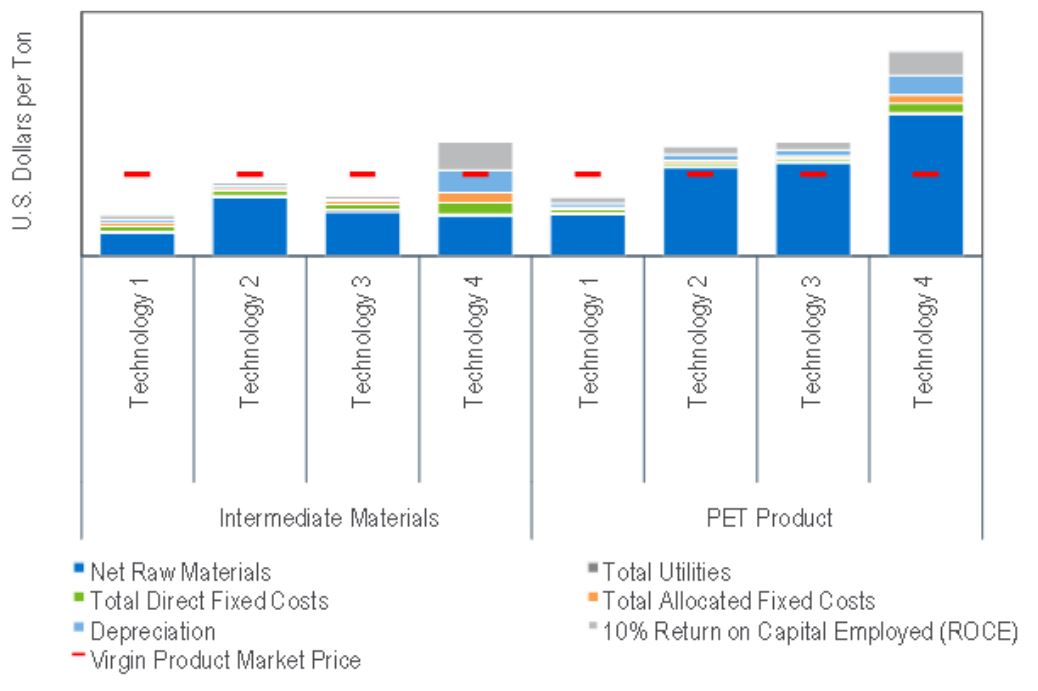
This analysis extends to detailed profiles of key technology licensors, owners, operators, and sorting technology providers, revealing the intricacies of their operations. Furthermore, the report presents a Cost of Production analysis across regions including US Gulf Coast (USGC), Western Europe, China, Japan, and Southeast Asia. These regional-specific insights spotlight market dynamics and the financial feasibility of intermediates such as rPET flakes, Bis-Het via both comprehensive and partial glycolysis, and DMT through methanolysis. The report compares rPET pellet prices with the Q1 2023 virgin market rate.
Cost of Production Summary – United States
(Basis: Q1 2023)
Final Considerations
While the path of PET recycling is laden with challenges—from supply shortages to competing with he price of tvirgin PET—the undercurrent of optimism is palpable. As public support grows, as industries recalibrate their sustainability goals, and as governments fortify their legislative mandates, PET recycling is not just a passing trend; it’s the future.
Navigating this future necessitates informed choices. Our Recycling Options for PET TECH report is tailored to guide you through them. For those eager to garner in-depth insights and contribute to the solution, we encourage you to delve into this report. Your journey into sustainable choices begins here.